Car Emergency Kit Checklist: What to Pack, How to Store It, and Why It Saves You More Than Money
Most drivers assume their phone, insurance app, and AAA membership constitute a complete safety net. The data from Ozark roads tells a different story.
Over 32 million drivers call for roadside assistance every year in the United States. Roughly 80% of those calls get resolved on-scene without requiring a tow. Flat tires represent 28% of service requests and dead batteries account for another 20%. These are problems a properly stocked car emergency kit checklist solves in minutes instead of hours.
Troop G, which covers the Branson area, recorded 38 traffic fatalities in 2025, a 22% increase from 2024. Rural response times in the Ozarks frequently exceed 60 minutes during peak tourism season, and after-hours surcharges add 25 to 50% to standard rates.
Concrete takeaway: A car emergency kit checklist isn't redundant insurance. It's the difference between waiting vulnerably and handling the majority of breakdowns yourself.
What Do 32 Million Roadside Calls Reveal About Preparedness Assumptions?
The popular myth is that modern technology has made physical preparedness obsolete. Local evidence contradicts this.
Urban response times average around 30 minutes. In the Springfield-Branson corridor, especially on US-65 and Route 76 after shows let out, waits stretch significantly longer when tow operators are already committed. Mobile flat tire repair in the Springfield-Branson corridor costs $89.99 per service call with a 45-minute estimated service time, compared to $20 - $50 for a professional patch-plug at a shop.
Concrete takeaway: Drivers who treat a car emergency kit checklist as optional frequently pay both the $89.99 mobile use our cost calculator and lose hours of travel time that could have been avoided.
Why Rural Ozark Drivers Face Different Realities Than Urban Assumptions Suggest
Many assume help arrives quickly regardless of location. Branson-area data shows this assumption requires validation.
Stone County’s year-round population is approximately 32,000, yet tourism volumes during May - October overwhelm local response capacity. Missouri recorded 2,228 motorcycle crashes resulting in 108 fatalities in 2022, with Taney County and surrounding Ozark tourism counties disproportionately represented during riding season.
Concrete takeaway: Your car emergency kit checklist must be built for extended rural wait times and higher incident volumes, not urban averages.
The Five Layers of a Functional Car Emergency Kit Checklist
Layer 1: Mechanical - Evidence Shows Two Problems Dominate Roadside Calls
Flat tires and dead batteries make up nearly half of all roadside service requests. A $10 tire pressure gauge addresses a documented risk: 70% of U.S. drivers hadn’t checked their tire pressure in the last 30 days despite monthly recommendations being standard.
A tire plug kit costs around $12. Professional mobile service on the Springfield-Branson corridor runs $89.99.
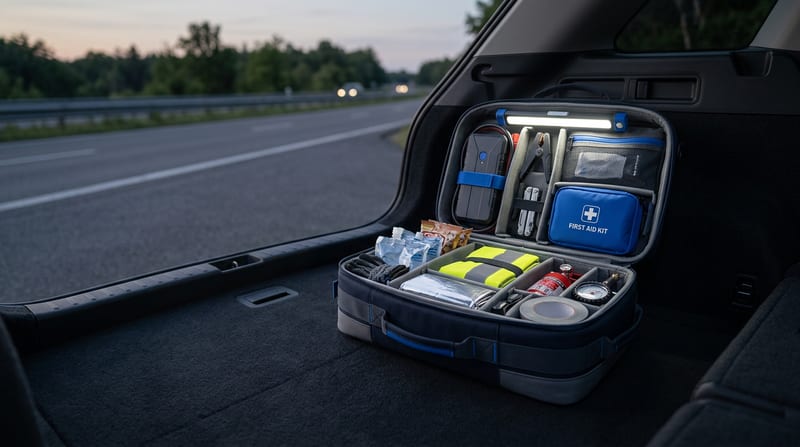
Concrete takeaway: Pack a tire pressure gauge, portable 12V air compressor, tire plug kit, lithium jump starter, and basic socket set. These items directly attack the two most frequent mechanical failures.
Layer 2: Medical - First Aid That Matches Local Crash Data
The assumption that minor first aid supplies are sufficient falls apart when examining regional crash statistics. With elevated motorcycle and vehicle incidents in Taney County from May through October, the first person on scene may be another driver.
Concrete takeaway: Carry trauma shears, compression bandages, gauze rolls, medical tape, and an instant cold pack. Treat the medical layer as potential first responder equipment, not just personal band-aids.
Layer 3: Survival - Evidence From Actual Ozark Breakdowns
The myth that “it won’t happen to me” or “help will arrive quickly” ignores documented three-hour waits on Route 76 during winter pileups. A metal vehicle loses heat rapidly once the engine is off.
Concrete takeaway: Include an emergency mylar blanket, wool blanket, rain poncho, and at least two bottles of water. These items turn a dangerous wait into a manageable one.
Layer 4: Communication - The Single Biggest Point of Failure
A dead phone battery is the most common complication in roadside emergencies. Cell coverage gaps exist throughout the Ozarks.
Concrete takeaway: Maintain two independent charging methods (power bank + car adapter) plus a whistle and reflective triangles as low-tech backups. Keep these items in your car emergency kit checklist and test them quarterly.
Layer 5: Comfort - Operational Stability Matters
Panic leads to poor decisions. Drivers with snacks, dry socks, and basic comforts make clearer choices while waiting.
Concrete takeaway: Add non-perishable snacks, wet wipes, a change of socks, and items for children or pets if applicable. Comfort isn't luxury. It's risk mitigation.
Item-by-Item Car Emergency Kit Checklist by Investment Level
$50 Essentials Tier (Covers 80% of Situations)
- Lithium jump starter (preferred over cables)
- Tire pressure gauge
- Portable 12V air compressor
- Basic first aid kit with compression bandage
- Three reflective warning triangles
- LED flashlight with extra batteries
- 10,000mAh power bank + charging cable
- Mylar emergency blanket
- Two bottles of water
- Basic tool set (pliers, adjustable wrench, screwdrivers, electrical tape)
Concrete takeaway: This combination costs less than a single local tow hookup fee and resolves the majority of breakdowns.
$200 Expanded Tier (Recommended for Ozark Drivers)
Add a tire plug kit, 20-foot rated tow strap, ABC fire extinguisher, second power bank, rain poncho, multi-tool, heavy work gloves, duct tape, and zip ties.
$500 Premium Tier (Remote or Frequent Travel)
Add two-way radio, solar charger, cold-weather sleeping bag, full trauma medical kit, and road flares.
How to Adjust Your Car Emergency Kit Checklist for Branson Seasons
Winter additions: Ice scraper, cat litter for traction, chemical hand warmers, extra wool blankets, and high-visibility vest. After-hours towing surcharges run 25-50% higher.
Summer and lake season additions: Double water supply, sunscreen, bug spray, and battery-powered fan. Tourism spikes create longer response times around Table Rock Lake and Silver Dollar City.
Concrete takeaway: Inspect and rotate your car emergency kit checklist quarterly. Test power banks, replace expired first aid items, and verify tire gauge accuracy. The inspection habit matters more than the initial purchase.
What It Actually Costs When You Skip the Kit
A local tow (0-5 miles) runs $75 - $125 in 2026, with medium-distance tows reaching $125 - $350 once per-mile charges and hookup fees are added. Storage fees begin immediately upon arrival at the lot.
AAA provides valuable backup but doesn't inflate tires, jump batteries on-site, or keep you warm during extended waits.
"One of the best ways to avoid this unexpected expense is to include emergency roadside assistance services with your motorcycle insurance policy. Other providers, such as AAA, provide add-on packages specifically for motorcycles." - Mike Navarette, motorcycle industry journalist
Concrete takeaway: Combine a well-maintained car emergency kit checklist with roadside coverage rather than choosing one over the other.
Storage and Organization That Actually Works
A jumbled trunk defeats the purpose. Use a waterproof duffel or hard-sided bin organized by layer with color-coded stuff sacks. Place mechanical items on top. Keep flashlight and reflective triangles accessible from the driver’s seat.
Practical implementation step: Create a small quick-access pouch clipped behind the driver’s headrest containing flashlight, charger, whistle, and cash.
Final concrete takeaway: The cheapest tow truck is the one you never have to call. A $50 - $200 car emergency kit checklist, inspected quarterly and tailored to Ozark conditions, delivers measurable returns in time, money, and safety for Branson-area drivers.
(/what-to-do-if-car-breaks-down-at-night)
(/flat-tire-help-branson-mo)
U.S. roadside assistance call volume and resolution rates