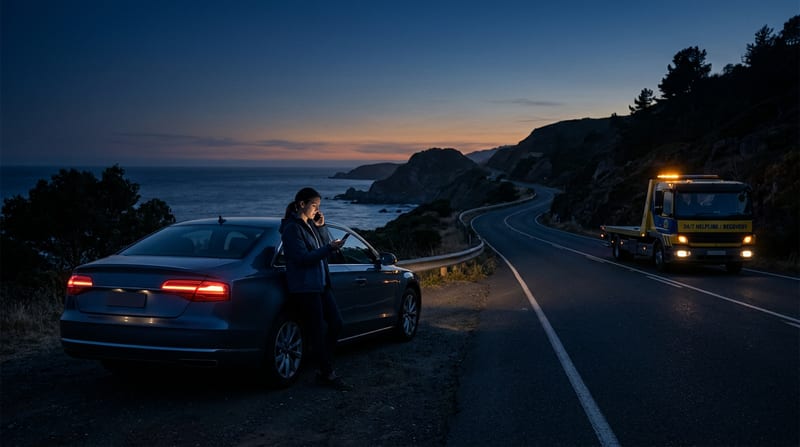
what to do if car breaks down at night costs vary widely depending on where you live and who you hire. Here are the real numbers.
What to Do If Your Car Breaks Down at Night
The First 60 Seconds: Immediate Actions When Your Car Breaks Down at Night
Your car breaks down at night and the clock starts. Not a metaphorical clock. A real one. Every second you sit dark and still on an unlit Ozark two-lane, you're a bowling pin waiting for a ball doing 55.
Troop G, which covers the Branson corridor, recorded 38 traffic fatalities in 2025, a 22% jump from 27 the year before (Missouri State Highway Patrol, 2025). A chunk of those happened after sundown on roads with no streetlights, no shoulders worth the name, and curves that sneak up on tired drivers leaving late shows. So what you do in the first 60 seconds isn't just about getting help. It's about not becoming a statistic.
Here's your short list. We'll break each one down.
- Hazards on immediately.
- Use remaining momentum to coast right, off pavement if possible.
- Set out reflective triangles or LED flares within 90 seconds.
- Decide: stay in or get out.
- Call for help in the right order.
And yes, the decisions you make right now also affect your wallet. After-hours and holiday towing surcharges in 2026 run 25 to 50% above base rates nationally (towingservicehub.com), so panicking into the wrong call costs you real money on top of real danger.
Hazard Lights, Momentum, and Getting Off the Road
Hazards first. Before you steer, before you brake, before you grab your phone. That button is muscle memory or it's nothing.
Now use whatever momentum you have. Engine dead? You're still rolling. Coasting into a parking lot, a wide spot, a driveway, anything paved and off the travel lane is your best outcome. Grass shoulder works. Gravel works. The ditch is better than the lane, I'm not kidding. I've pulled cars from ditches a hundred times and the drivers were alive to complain about the mud. Can't say that for everyone I've found sitting dark in a traffic lane at 11 PM.
Pump your brakes gently as you slow. Transmission in neutral if the engine stalled but the electrical still works. Park once stopped. Wheels turned away from traffic.
Making Yourself Visible: Reflective Triangles, Flares, and Phone Flashlights
Grab your kit. Reflective triangles go behind your vehicle: one at 10 feet, one at 100 feet, one at 200 feet. That's the FMCSA standard for commercial vehicles and it works for your Honda Civic too.
No triangles? LED flares. Not traditional road flares (those chemical sticks are legitimate fire hazards near a fuel leak, and if your car just died violently, you don't know what's leaking). LED units clip to your trunk lip, sit on the asphalt, flash for 36 hours on a single battery. Five bucks at any truck stop. The best insurance you'll never file a claim on.
Phone flashlight as absolute last resort. Prop it on the rear dash facing backward. It's not great, and but it's something.
Stay Inside or Get Out? A Decision Framework Based on Road Type
The conventional wisdom says stay in your vehicle with your seatbelt on. And most of the time, that's right. Your car is a 3,000-pound shield between you and whatever comes next.
But.
If you're stopped on a narrow mountain road with no shoulder, a blind curve behind you,. And headlights already sweeping around that bend, staying inside might mean absorbing a rear-end impact at highway speed. I've worked those scenes. They're ugly.
So here's my framework, and I'm honestly not sure it covers every scenario because roads are weird and situations are weirder:
Highway or interstate with wide shoulder: Stay inside. Seatbelt on. Wait for help.
Rural two-lane, no shoulder, blind curve behind you: Get out. Get everyone out. Move at least 50 feet from the vehicle, uphill and away from traffic. Take your phone and your visibility gear.
Urban street with low speeds: Stay inside. Lock doors. Hazards blinking.
The key variable is whether an approaching vehicle can see you in time to stop. If the answer is "probably not," you leave the car.
How Much a Nighttime Breakdown Actually Costs: Towing, Repairs, and Surcharges
Here's what bugs me about every cost article online. They quote you a daytime base rate like that's what you'll pay. It's not, and You broke down at night. The rules change.
Average Towing Costs by Distance: 5, 50, and 100 Miles
The baseline numbers, which apply during business hours on a clear Tuesday: roughly $75 for 5 miles, $200 for 50 miles, and $325 for 100 miles, with hook-up fees ranging from $50 to $250 depending on the operator and your vehicle's situation (towingservicehub.com). Those hook-up fees are the thing that'll bite you because they apply before the truck moves an inch. Think of it like a restaurant cover charge, except the restaurant is a flatbed and the meal is your car.
Run the numbers for your specific situation: calculate costs.
After-Hours and Holiday Surcharges You Should Expect
Now layer on the night premium. A 25 to 50% surcharge on that 50-mile tow turns $200 into $250 to $300. Break down on July 4th weekend in Branson? I've seen quotes north of $350 for the same distance. The tow company isn't gouging you (well, most aren't). They're paying a driver overtime, burning fuel on roads with deer crossings, and taking on liability for a hookup in the dark on a slope. It costs what it costs.
The real number that matters: Missouri doesn't cap rates for consensual towing, meaning the tow you request yourself (towingservicehub.com). Operators set their own prices. During peak tourism weekends, supply and demand do what supply and demand always do.
Flat Tire, Dead Battery, or Lockout: Comparing Common Roadside Repair Costs
Not everything needs a tow.
Mobile flat tire repair in the Springfield-Branson corridor runs about $89.99 per service call with a 45-minute estimated service time, compared to $10 to $30 at a stationary shop where you can drive the car in yourself. That's a steep markup, but at midnight on Route 76, your options are limited.
A professional tire patch-plug costs $20 to $50 nationally in 2026, so the real expense isn't the repair. It's the guy driving out to you at 1 AM.
Battery jump: somewhere around $50 to $100 for a mobile service call. Lockout: $50 to $150 depending on your vehicle and how fancy the locks are. These are the scenarios where an 80% resolution rate without a tow applies (roughly 80% of the estimated 88 million annual U.S. roadside assistance calls get resolved on-site without needing a tow, per industry data from 2022).
Who to Call and in What Order: Building Your Nighttime Breakdown Contact Chain
The U.S. towing sector has over 68,000 companies generating more than $8 billion in annual revenue. Options exist. Quality doesn't distribute evenly.
911 vs. Non-Emergency Lines: When Each Applies
Call 911 if there's an injury, a safety hazard (you're blocking a lane on a highway, your car is smoking, there's a fuel spill), or you feel threatened. Full stop, and Don't worry about "bothering" dispatchers. That's what they're there for.
Non-emergency line (in Taney County that's the sheriff's office) if you're safely off the road but want an officer to set up a warning for approaching traffic while you wait. Useful on those dark Ozark stretches where your hazard lights are the only light source for a quarter mile.
Roadside Assistance Through Insurance, AAA, or Manufacturer Programs
Before you Google "tow truck near me" at midnight, check what you already have.
"One of the best ways to avoid this unexpected expense is to include emergency roadside assistance services with your motorcycle insurance policy. Other providers, such as AAA, provide add-on packages specifically for motorcycles," says Mike Navarette, motorcycle industry journalist. Same logic applies to cars. Your auto insurance policy, your credit card, your manufacturer warranty (most new vehicles include 3 to 5 years of roadside), even your cell phone plan (T-Mobile and some others bundle basic roadside). One of these probably covers you right now and you've never checked.
AAA's Premier tier covers towing up to 200 miles per call. That's worth knowing when you're 80 miles from home on a dark mountain road.
Hiring a Tow Company Directly: Red Flags and Verification Steps
Now for the part nobody talks about enough. Predatory tow operators monitor police scanners. They show up at nighttime breakdowns uninvited, quote you a price that sounds reasonable, then hit you with "storage fees". And "special equipment charges" once your car is on the hook. I've watched it happen.
The president of the Missouri Tow Truck Association put it bluntly: "Right now, you could have one driver make a small mistake, which technically violates an industry regulation." If the professionals are worried about their own industry's margins for error, you should be doing your homework before someone hooks up your vehicle.
Verification steps before you authorize anything:
- Ask for the company name and physical address.
- Ask for their DOT number or Missouri nonconsent towing permit number.
- Get a per-mile rate and total estimate in writing (text message counts).
- Ask if there's an after-hours surcharge and what it's, specifically.
- If they won't answer these questions, they don't touch your car.
Branson and Ozark-Specific Risks: What Makes a Night Breakdown Here Different
This isn't Phoenix. This isn't Dallas. Breaking down at night in the Ozarks is its own particular breed of problem, and I say that as someone who's worked these roads for years.
Poorly Lit Mountain Roads and Limited Cell Coverage
Missouri recorded 2,228 motorcycle crashes resulting in 108 fatalities in 2022, with Taney County and surrounding Ozark tourism counties disproportionately represented during the May through October riding season (Missouri Department of Transportation, 2022). Cars fare better in crashes than bikes, obviously, but the road conditions that cause those crashes, no lights, steep grades, tight curves, affect everyone.
Cell coverage is the sneaky killer of good plans. You can have AAA, full insurance, three emergency contacts programmed, and none of it matters if your phone shows "No Service" at the bottom of a hollow on Route 165. Pre-download offline maps before you drive these roads. Carry a portable battery pack. And here's the thing nobody does but should: note the mile markers as you drive. When you call for help and can say "I'm at mile marker 14 on Highway 76 westbound," you just cut your wait time by 20 minutes because the dispatcher doesn't have to play geography games with you.
See response-time estimates and pricing for your area: check your service area.
Entertainment Traffic Patterns: Show Letout Hours (9 to 10 PM) as Peak Incident Windows
Branson shows let out between 9 and 10 PM. That's when 76 Country Boulevard goes from "busy" to "parking lot clearing at once." Tired tourists, unfamiliar roads, dark conditions, maybe a drink at dinner three hours ago that's still doing its work. This is peak incident time on poorly lit Ozark roads, and the after-hours towing surcharges kick in right as the demand spikes.
The timing is almost comically bad. The hour when you're most likely to need help is the hour when help costs the most and takes the longest to arrive.
Rural Response Times: What to Realistically Expect
MTTA focus group participants have said that "towing operators feel exposed in remote/rural areas" and expect traffic control assistance from MoDOT. If the professionals feel exposed, think about what that means for your wait time. They're not rushing blind around mountain curves to get to you faster.
Realistic response times in the Branson corridor at night: 30 to 60 minutes if you're on a main road, 60 to 90 minutes if you're on a secondary route, and potentially longer if you're deep in the rural county roads south of Branson or up toward the Mark Twain National Forest. Plan your provisions accordingly. Water, a blanket, a charged phone, patience.
The Financial Safety Net: Why Roadside Assistance Plans Pay for Themselves at Night
Comparing Plan Costs vs. a Single After-Hours Tow
Here's the math that should make this decision easy. A single nighttime 50-mile tow with surcharge runs $250 to $300. A basic roadside assistance plan costs $50 to $150 per year. One call. One breakdown. The plan pays for itself and then some.
AAA's motorcycle add-on runs $25 to $60 per year and covers up to 200 miles per tow on the Premier tier (towingservicehub.com). Standard auto coverage is similar. Use our calculator to compare plan savings vs. out-of-pocket costs: calculate costs.
What Most Plans Actually Cover (and the Fine Print They Don't)
I wish I could tell you every plan is a slam dunk. They're not.
Basic tiers often cap towing at 5 to 10 miles. If you break down 40 miles from the nearest shop, you're paying the difference out of pocket. Some plans exclude vehicles over certain weights (relevant if you drive a heavy truck or RV through the Ozarks). Wait-time guarantees sound great in the brochure but they're essentially unenforceable, there's no penalty clause if the truck takes 90 minutes instead of the promised 45.
And flatbed trucks, the safest transport method for most vehicles, represent only about 25% of the tow truck fleet market. At 11 PM, the flatbed might already be on another call. Your plan might send a wheel-lift truck instead, which is fine for most cars but not ideal if you have a low-clearance vehicle or all-wheel drive.
When Self-Pay Makes More Sense Than a Plan
If you drive a newer vehicle still under manufacturer warranty (which almost always includes roadside assistance), paying for a separate plan is redundant. Check your warranty terms first. Toyota, Honda, Hyundai, and most others include 3 to 5 years of coverage.
Self-pay also makes sense if you rarely drive outside urban areas, have a reliable vehicle with good maintenance history, and keep an emergency fund that can absorb a $200 to $300 surprise without stress. The plan is insurance against a bad night. If your nights are generally good, maybe you pocket the premium.
I'm not sure there's a universally right answer here. It depends on how much you drive these Ozark roads and how much a surprise $300 bill would hurt.
Preventive Steps That Reduce Nighttime Breakdown Risk by 70%+
The cheapest breakdown is the one that never happens. Obvious? Sure. But 70% of U.S. drivers hadn't checked their tire pressure in the last 30 days despite monthly checks being the standard recommendation. We know what to do, and we just don't do it.
The Pre-Trip Inspection Checklist: Tires, Battery, Fluids, Lights
Five minutes before you leave. That's all this takes.
Tires: visual check for bulges, cracks, embedded objects. Press your thumb into the tread; if it feels shallow, it probably is. Check pressure with a gauge (not your eyes, your eyes are terrible at this). Target pressure is on the sticker inside your driver's door jamb, not on the tire sidewall.
Battery: if your engine cranks slowly on startup, the battery is telling you something. Listen. Most auto parts stores will test it free.
Fluids: oil level, coolant level, windshield washer (that last one matters more at night than you think, when oncoming headlights turn a dirty windshield into a wall of glare).
Lights: headlights, taillights, brake lights, turn signals. Walk around the car, and Takes 30 seconds. A burned-out taillight at night is a rear-end collision waiting to happen.
Building a Night-Specific Emergency Kit
Your trunk should have:
- Reflective vest (bright enough to make you look like a traffic cone, which is the point)
- LED flares, minimum three
- Portable jump starter (they're the size of a paperback book now, $40 to $80, and they work)
- Tire sealant can (with a caveat I'll get to)
- Phone charger, the portable battery kind, fully charged before every trip
- Flashlight with fresh batteries, not your phone
- Blanket and water bottle
That kit costs maybe $120 total and fits in a shoebox-sized bag. It's the difference between a manageable inconvenience and a genuinely scary night.
Tire Maintenance: The Single Highest-ROI Prevention Step
Flat tires account for 9% of all automotive service sales in the U.S. Nine percent. That's the single most common roadside issue, and it's almost entirely preventable.
The numbers are grim when prevention fails: 664 people died in tire-related crashes in 2020, with underinflation and worn tread as leading contributing factors (NHTSA, 2020). Underinflation doesn't just cause blowouts. It causes poor handling, longer stopping distances, and reduced fuel economy that you don't even notice until something goes wrong at the worst possible moment on the worst possible road.
Check pressure monthly. Cold pressure, meaning before you drive, not after. Replace tires when the tread depth hits 4/32 of an inch (the common advice is 2/32,. But on wet Ozark mountain roads at night, that extra 2/32 is the difference between stopping and sliding).
One skeptical note on tire sealant: it works as a temporary fix to get you to a shop, but it can damage your TPMS sensor (the tire pressure monitoring system) and some shops will charge you extra to clean the goop out before doing a proper repair. Know the trade-off before you spray it. It's a "get me off this dark road" tool, not a real fix.
What NOT to Do: Common Nighttime Breakdown Mistakes That Escalate Danger and Cost
I've seen every version of this go wrong. Let me save you the education.
Attempting Roadside Repairs in Traffic Lanes
Changing a tire on a dark shoulder without a reflective vest, without flares, without triangles, is one of the highest-risk DIY decisions a driver can make. Those 38 Troop G fatalities in 2025 include people who were outside their vehicles on or near the roadway (Missouri State Highway Patrol, 2025). A passing driver drifts two feet, maybe checking their phone, maybe adjusting the radio, and you're the thing they hit.
If you can't get fully off the road, if you can't illuminate your position, if traffic is moving fast. And close, don't get under your car or crouch beside it in the dark. Call for help, and Wait inside. The cost of a tow is always less than the cost of getting struck.
Accepting an Unsolicited Tow Without a Written Estimate
A truck shows up, and You didn't call anyone. The driver says he was "in the area" and offers to help. Sounds nice, right?
Get a written estimate before that hook touches your bumper. Ask for the company name, and Ask for the per-mile rate. Ask about storage fees. If the driver gets irritated by questions, that tells you everything. Legitimate operators expect questions and answer them clearly because they want repeat business and good reviews, not a one-time gouge on a stranded tourist.
Review our methodology for how we track regional towing costs and response times: see our methodology.
Leaving Your Vehicle Unattended Without Proper Notification
Here's what happens if you walk away from your car on a Missouri state highway without notifying anyone: MoDOT can have it towed after a set period, and you're on the hook for the tow plus daily impound storage fees that start accruing immediately. I've seen people pay more in storage fees than the tow itself because they didn't know the clock was ticking.
If you leave your vehicle (to walk to a gas station, to get a ride home, whatever), call the non-emergency line for the county you're in and tell them. Note the location, mile marker, and which direction you were traveling. Leave a note on the dashboard with your name, phone number, and the date and time you left the vehicle. This won't guarantee it stays put, but it gives you a fighting chance of avoiding a surprise impound bill.
And lock the doors, and even in the Ozarks. Especially at night. A dark, unattended vehicle on a rural road is an invitation for theft, and your insurance deductible on a break-in is another cost you didn't budget for on what was supposed to be a nice evening out in Branson.
Grab your kit, and Check your tires. Know your numbers before you need them. That's the whole game. Back on blacktop beats stranded in the dark every single time.